

Decades of Performance: Separating Fact from Fiction in EV Battery Longevity
Are you considering an electric vehicle but find yourself hesitant due to lingering questions about battery lifespan? It's a common concern, often fueled by outdated information or sensationalized claims. In 2026, with millions of electric miles logged and extensive real-world data available, we can confidently address these anxieties. Modern EV batteries are proving to be remarkably durable, consistently exceeding initial expectations and offering a lifespan that often surpasses the vehicle itself.
This comprehensive guide dives deep into the most current, data-backed insights on EV battery longevity. We'll explore average degradation rates, the influence of battery chemistry and climate, what manufacturers truly guarantee, and practical tips to maximize your EV's battery life. Prepare to replace skepticism with informed confidence as we debunk myths and reveal the robust reality of today's electric vehicle power packs.
Key Insights: EV Battery Lifespan in 2026
- Remarkable Durability: Modern EV batteries typically last between 15-20 years before experiencing significant degradation that impacts daily usability.
- Gradual Degradation: Real-world studies show an average capacity loss of only 2-3% per year under normal driving and charging conditions.
- Exceeding Warranties: Most batteries retain 80-85% of their original capacity after 8 years, significantly outperforming manufacturers' typical 70% warranty guarantees.
Debunking Common Myths About EV Battery Longevity
Before we dive into the granular data, let's address some pervasive misconceptions that often cloud the discussion around EV battery life. The reality, supported by extensive research and real-world usage, paints a much more reassuring picture.
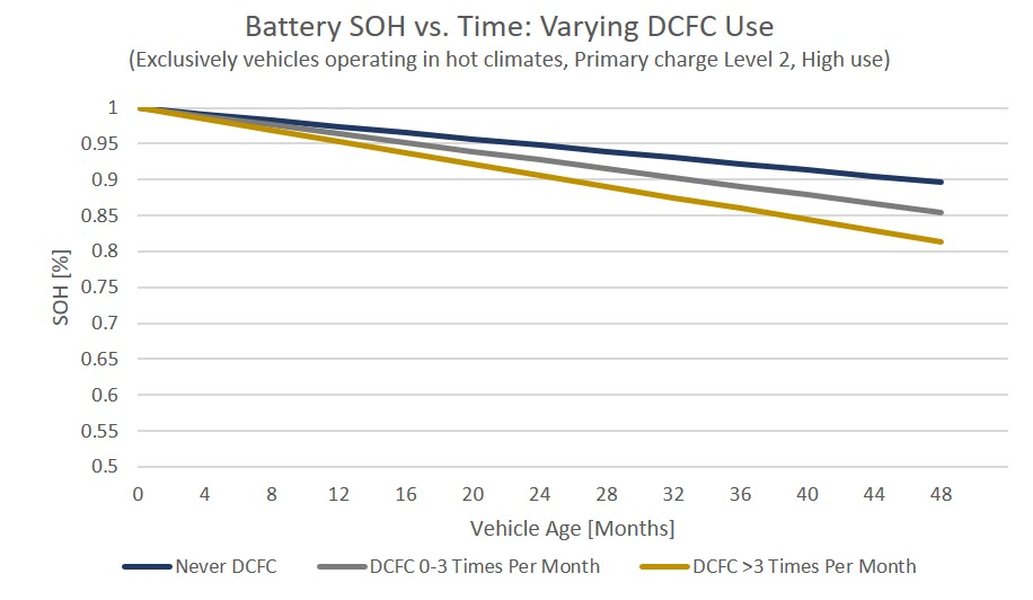
Real-world data consistently demonstrates a gradual and predictable degradation pattern in EV batteries.
Myth vs. Reality: Clearing the Air
- Myth: EV batteries "die" after 5 years, leading to expensive replacements.
Reality: Modern EV batteries are designed with sophisticated Battery Management Systems (BMS) and advanced thermal management, allowing them to last much longer. Studies show the average EV battery retains around 90% of its original capacity after 6.5 years, and many older vehicles are still on the road with excellent battery health. - Myth: Frequent fast charging destroys the battery.
Reality: While excessive high-power DC fast charging can slightly accelerate degradation, modern EVs are equipped to handle it. Their thermal management systems actively cool the battery during fast charging to mitigate stress. A balanced charging approach, primarily using Level 2 AC charging for daily needs and DC fast charging for road trips, ensures optimal battery life. - Myth: All EV batteries degrade at the same rate.
Reality: Degradation rates vary significantly based on battery chemistry, the vehicle's thermal management system, and individual usage patterns. Advancements in battery technology, such as LFP chemistry, offer even greater longevity. - Myth: Cold weather permanently damages EV batteries.
Reality: Cold temperatures temporarily reduce range and charging speed, but they have less impact on long-term degradation compared to high heat. Battery preconditioning systems help manage cold-weather performance without causing permanent damage.
Real-World Degradation Rates: What the 2026 Data Reveals
Thanks to large-scale telematics studies and independent analyses tracking tens of thousands of electric vehicles over many years, we now have an unprecedented understanding of how EV batteries perform in the real world. This data is crucial because it accounts for various driving conditions, climates, and charging habits, offering a more accurate picture than laboratory tests alone.
Average Capacity Loss: A Gentle Decline
The most comprehensive analyses, including a 2026 study examining over 22,700 electric vehicles across 21 models, indicate an average battery degradation rate of approximately 2.3% per year. This rate is a gradual, predictable decline, not a sudden drop-off. A significant 2024 study in Nature Energy even found that EV batteries in real-world conditions tend to last up to 33% longer than initial laboratory predictions, highlighting the effectiveness of modern EV engineering.
- For vehicles with low fast-charging usage, degradation can be as low as 1.5% per year.
- Even after 150,000 miles, many EV batteries maintain over 80% of their original health.
Battery State of Health (SoH) Over Time
Key findings from various studies consistently show impressive capacity retention:
- The average EV battery retains 90% of its original capacity after 6.5 years of service.
- Fleet data suggests EV batteries typically retain an average of 81.6% of capacity after eight years.
- A major 2026 study that analyzed over 8,000 electric cars and vans from 36 manufacturers reported an average battery "state of health" (SoH) of an impressive 95.15% of original capacity. Even older vehicles (8 to 12 years old) showed a median battery health of 85%, with the lower quartile averaging 82%.
This data underscores that EV batteries are designed to comfortably outlast the average vehicle lifespan, which was around 13 years in the US as of last year.
Understanding Battery Aging: Calendar vs. Cyclic
Electric vehicle batteries, predominantly lithium-ion, undergo two primary forms of aging that contribute to their gradual capacity loss:
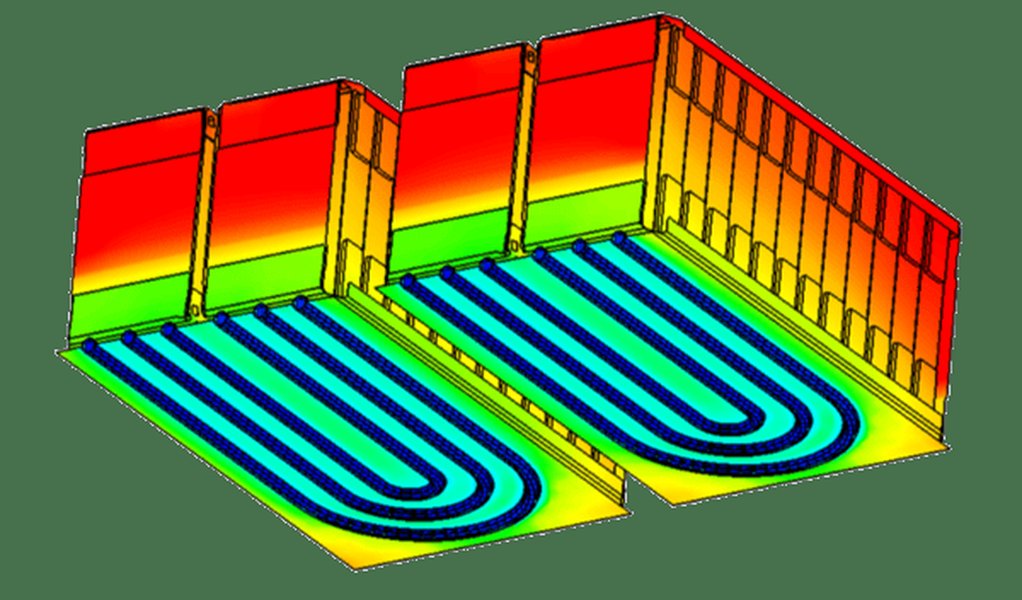
Advanced thermal management systems, like those using U-shaped cooling plates, are crucial in mitigating battery aging.
Calendar Aging: The Silent Passage of Time
Calendar aging refers to the natural degradation that occurs simply due to the passage of time, regardless of how often the battery is used. This is similar to how any chemical system degrades over time. Factors influencing calendar aging include:
- Time Elapsed: The older a battery is, the more it will have degraded, even if it hasn't been driven much.
- Average Storage Temperature: High ambient temperatures can accelerate internal chemical reactions that lead to degradation.
- Long-Term State of Charge (SoC): Storing a battery at very high (near 100%) or very low (near 0%) charge for extended periods can increase calendar aging stress.
Cyclic Aging (Usage-Based Wear): The Impact of Charging and Discharging
Cyclic aging relates to the wear and tear caused by repeated charging and discharging cycles. Each time the battery is used, it undergoes microscopic changes that gradually reduce its capacity. Key factors affecting cyclic aging include:
- Depth of Discharge: Draining the battery completely and then fully recharging it (a deep cycle) typically causes more stress than partial charge/discharge cycles.
- Charging Speed and Methods: Frequent high-power DC fast charging can generate more heat and stress on the cells, potentially accelerating cyclic aging compared to slower AC charging.
- Operating Temperature: Charging and discharging the battery in extreme temperatures (especially very hot) can intensify cyclic degradation.
In most modern EVs under typical usage patterns, approximately 70% of degradation is attributed to cyclic aging, and 30% to calendar aging. Advanced Battery Management Systems (BMS) play a critical role in mitigating both types of aging by intelligently controlling charging, discharging, and thermal conditions to keep the battery within optimal operating parameters.
What Degradation Looks Like: Real-World Expectations by Time and Mileage
It's important to understand that EV battery degradation is a gradual process, not a sudden failure. The perception of "losing" range is often a slow, almost imperceptible decline over many years. Here’s a realistic breakdown based on 2026 data:
Typical Capacity Retention in Normal Mixed Use (2026 Reality)
| Age / Mileage | Capacity Most Owners Observe | What It Means for Range |
|---|---|---|
| 3 Years / ~30,000–45,000 miles | ~92–97% | Little to no practical change in daily driving range. |
| 6–8 Years / ~80,000–120,000 miles | ~80–90% | Range typically down 10–20% compared to new. Still ample for most commutes. |
| 10 Years / ~120,000–160,000 miles | ~78–88% (chemistry- and climate-dependent) | Still very usable for most commutes; may require one extra charging stop on very long road trips. |
| 15 Years / High Mileage | ~70–85% | Usable range shrinks further, but remains predictable. Many owners continue driving without issues, especially for local travel. |
Pro Tip: Vehicles that frequently use heavy DC fast charging and are persistently parked in high heat will likely see results at the lower end of these ranges. Conversely, those primarily using gentle Level 2 AC charging and parking in shaded areas will experience less degradation.
How Battery Chemistry and Climate Affect Longevity
The type of battery chemistry and the climate an EV operates in are two significant factors influencing its long-term health and degradation rate.
Battery Chemistry: LFP vs. NMC/NCA
Not all lithium-ion batteries are created equal. The two most common chemistries in electric vehicles offer different trade-offs:
- NMC (Nickel Manganese Cobalt) / NCA (Nickel Cobalt Aluminum):
- Strengths: High energy density, offering longer range for a given battery size. Commonly used in many longer-range and performance EVs.
- Characteristics: More sensitive to being charged to 100% daily, especially in hot climates. Prefers daily charging targets between 70-90% to maximize lifespan. Moderate degradation rate (2-3% per year).
- Used by: Many Tesla, BMW, Ford, Hyundai, and Kia models.
- LFP (Lithium Iron Phosphate):
- Strengths: Excellent longevity and cycle life, highly tolerant to frequent 100% charges, and very stable. Often found in standard range models.
- Characteristics: Slightly lower energy density (meaning a slightly shorter range for the same physical battery size) and can experience more temporary range reduction in very cold weather. Less sensitive to full charging cycles.
- Used by: Tesla Standard Range models, BYD, and many Chinese EV manufacturers.
- Best Practice: Periodically charging LFP batteries to 100% (e.g., once a week or month) is often recommended to help the Battery Management System (BMS) calibrate and provide accurate range estimates.
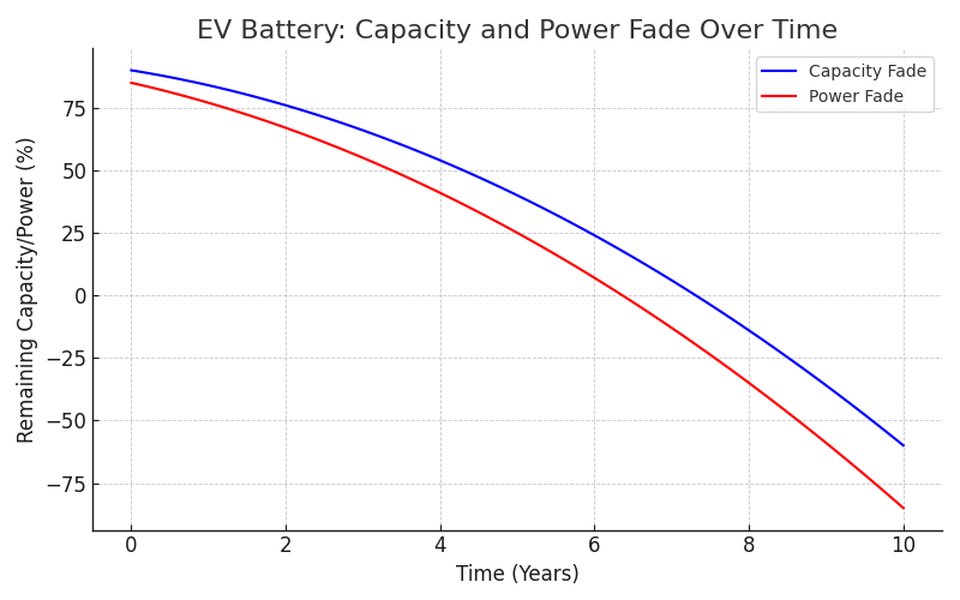
Different battery chemistries exhibit varied degradation patterns over time.
Climate Impact: Heat vs. Cold
Temperature significantly impacts battery chemistry and performance. Modern EVs are designed to counteract these effects with sophisticated thermal management systems, but external conditions still play a role:
- Hot Climates:
- Effect: Consistent exposure to high temperatures (above 95°F or 35°C) can accelerate the chemical reactions within the battery cells that lead to degradation.
- Mitigation: Modern liquid cooling systems are highly effective. Parking in the shade, using garage facilities, and avoiding charging to 100% then leaving it in extreme heat can help reduce stress. Vehicles in hot climates might see 10-15% faster degradation than those in moderate climates.
- Cold Climates:
- Effect: Freezing temperatures temporarily reduce the battery's available power and range (sometimes up to 40%) and slow down charging speeds. This is a temporary reduction, not permanent damage.
- Mitigation: Thermal management systems use preconditioning to warm the battery before driving or charging, restoring performance. While cold temporarily affects usability, its impact on long-term degradation is generally less severe than extreme heat, possibly leading to 5-10% faster degradation compared to moderate climates. LFP batteries can be more affected by temporary cold-weather range reduction.
Pro Tip: Parking your EV in a garage during extreme temperatures—hot or cold—can significantly contribute to preserving its battery health over time.
Warranty vs. Reality: Manufacturer Guarantees and Actual Performance
Most EV manufacturers provide substantial warranties for their battery packs, offering a crucial safety net for owners. However, real-world data consistently shows that batteries perform significantly better than these minimum guarantees.
Federal and State Warranty Requirements
In the United States, federal law mandates an EV battery warranty of at least 8 years or 100,000 miles (whichever comes first). This warranty typically guarantees that the battery will retain at least 70% of its original capacity. Some states, particularly those following California emissions regulations, may extend this coverage further, sometimes to 10 years or 150,000 miles.
Typical Warranty Coverage and Real-World Outcomes
Here’s a snapshot of common battery warranty terms and how they compare to actual observed performance:
| Manufacturer (Typical) | Warranty Period | Capacity Guarantee | Real-World Performance (After Warranty Period) |
|---|---|---|---|
| Tesla | 8 years / 100k-150k miles (model dependent) | 70% | 80-85% after 8 years |
| Hyundai | 10 years / 100k miles | 70% | 79-82% after 10 years |
| Ford | 8 years / 100k miles | 70% | 78-81% after 8 years |
| Nissan | 8 years / 100k miles | 66% | 75-79% after 8 years |
| GM | 8 years / 100k miles | 70% | 79-82% after 8 years |
The crucial takeaway here is that these warranties represent a minimum threshold. In practice, fewer than 1% of EV batteries require replacement during the warranty period due to capacity loss, as most perform well above the guaranteed minimum. The average battery health often remains above 95% even after several years, rarely approaching the 70% warranty trigger.
What Can Void Your Warranty? While terms vary, modifying the battery pack or its management system, accidental damage, improper repairs, or failure to follow recommended maintenance schedules can potentially void a warranty. However, these situations are typically rare and avoidable with responsible ownership.
Realistic Expectations: What to Expect at 10, 15, and 20 Years
Based on current trends and data from the oldest EVs on the road, the longevity of electric vehicle batteries is a true highlight of modern automotive engineering. Here’s what you can realistically expect from your EV battery over extended periods:
After 10 Years
Most modern EV batteries are projected to retain 75-80% of their original capacity. For a vehicle with an original 300-mile range, this would still provide 225-240 miles of usable range. This minimal reduction typically has little to no impact on daily driving for most users. You might notice a slightly reduced charging speed on some occasions, but overall functionality remains strong.
After 15 Years
At the 15-year mark, average capacity may drop to 70-75% of original. Using the 300-mile example, this translates to 210-225 miles of range. At this point, some owners might consider battery refurbishment, but for many, the vehicle will still be perfectly adequate for local driving and even occasional longer trips with careful planning. The oldest EVs are demonstrating that 15+ years of reliable service is very achievable.
After 20 Years
While data on 20-year-old EVs is still emerging, the longest-running vehicles indicate capacity retention between 60-70%. This would mean 180-210 miles from an original 300-mile range. At this stage, the battery might require module replacement or refurbishment to restore more significant capacity, or the vehicle could continue to be used effectively with its reduced but predictable range. With advancements in battery technology and repair options, even older EVs will have viable pathways for continued use.
"The oldest EVs on the road are proving that batteries can last 15-20 years with reasonable capacity retention. We're seeing 12-year-old vehicles with 80% capacity still in daily use."
Tips to Maximize Your EV Battery's Lifespan
While modern EV batteries are incredibly robust, adopting smart charging and driving habits can further extend their life and ensure optimal performance for years to come.
- Adhere to the 20-80% Rule (for NMC/NCA batteries): For daily driving, aim to keep your battery's charge level between 20% and 80%. This reduces chemical stress on the cells. Only charge to 100% when you anticipate needing the full range for a long journey.
- Embrace Full Charges for LFP Batteries: If your EV has an LFP battery, periodically charging it to 100% (e.g., once a week or month) is beneficial. This helps the Battery Management System (BMS) calibrate accurately, ensuring correct range estimates.
- Prioritize Level 2 AC Charging: For everyday charging at home or work, rely on Level 2 (240V AC) charging. While convenient for road trips, frequent high-power DC fast charging (especially above 80% charge) can cause slightly more stress than slower AC charging.
- Avoid Extreme Temperatures: Park your EV in the shade during hot weather and in a garage in cold climates. Modern thermal management systems help, but reducing external temperature stress is always beneficial.
- Don't Leave it Parked at Extreme Charge Levels: Avoid leaving your EV parked for extended periods with a very low (under 20%) or very high (over 80-90%) state of charge.
- Regular Maintenance: Although EVs require less maintenance than internal combustion engine cars, ensure your EV's cooling system (radiator, coolant) is checked and maintained as recommended. A well-functioning cooling system is critical for battery health.
- Keep Software Updated: Manufacturers often release software updates that include improvements to the Battery Management System, optimizing charging algorithms and thermal control for better longevity and accuracy.
The Future of EV Battery Longevity
Battery technology is far from stagnant; it's a rapidly evolving field. Ongoing research and development promise even longer lifespans, faster charging, and improved safety for future EV batteries.
- Solid-State Batteries: These next-generation batteries promise significantly higher energy density (potentially 2-3x current lithium-ion), faster charging (10-80% in under 10 minutes), and even longer lifespans (10,000+ cycles). While not yet mainstream, they are on the horizon.
- Advanced Thermal Management: Continuous improvements in cooling and heating systems will further refine temperature control, leading to reduced degradation across all climates.
- Improved Chemistries: New electrolyte formulations and anode/cathode materials are being developed to resist breakdown over time, enhancing durability.
- AI-Powered BMS: Smarter Battery Management Systems, leveraging artificial intelligence, will optimize charging and discharge cycles in real-time to proactively extend battery life.
When Might a Battery Need Attention or Replacement?
Despite their exceptional longevity, EV batteries are not immortal. However, the need for full battery replacement is far less common than many believe, and costs are trending downwards.
- Significant Capacity Loss: The primary reason for a battery to need attention is when its usable range no longer meets the owner's daily needs. This is a gradual process, not a sudden failure.
- Module Failure: A more common scenario is the failure of individual battery modules within the larger pack. Many service centers now offer module-level repairs or replacements, which are significantly less expensive than replacing the entire battery pack.
- Accident Damage: Severe collisions can damage battery packs, necessitating repair or replacement. However, these are typically covered by vehicle insurance.
Good News: The cost of EV battery replacement has fallen dramatically, decreasing by over 60% since 2020. This trend is expected to continue, making potential out-of-warranty replacements much more affordable in the future.
Conclusion: Drive Your EV with Confidence
The anxieties surrounding EV battery longevity are, in large part, a relic of early-generation electric vehicles and outdated information. Today's real-world data, collected from millions of miles driven across diverse climates and usage patterns, overwhelmingly confirms that modern EV batteries are engineered for the long haul.
With typical degradation rates of just 2-3% per year, comprehensive warranties that act as a strong safety net, and proven strategies for extending battery life, EV owners in 2026 can embrace electric mobility with genuine peace of mind. The battery is highly likely to outlast your ownership period, offering reliable performance and significant long-term savings on fuel and maintenance. Your EV's heart is built to endure, ensuring a dependable and enjoyable driving experience for many years to come.
